
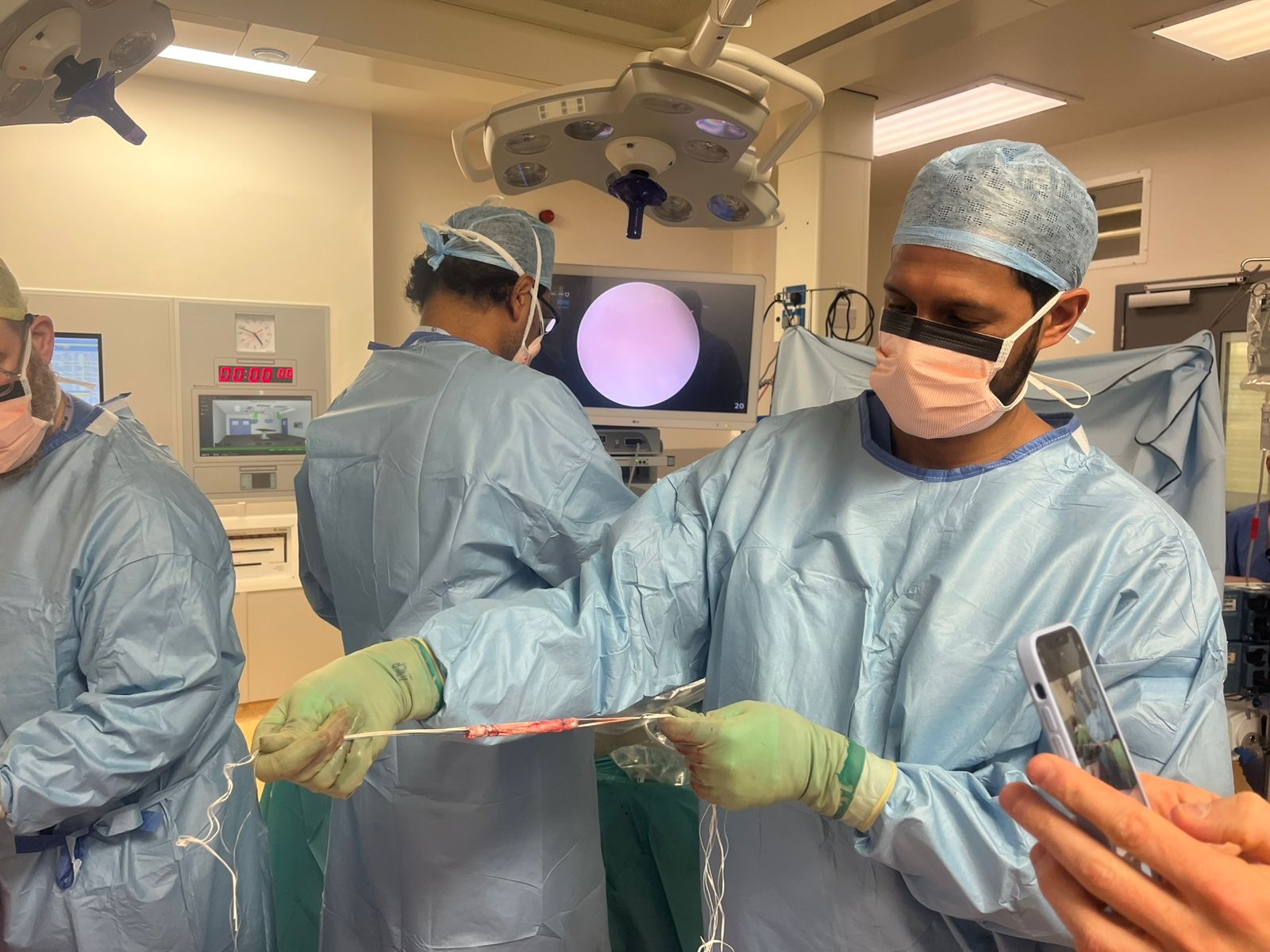
By Mr Osman Riaz | Consultant Orthopaedic Knee Surgeon | Yorkshire Sports Knee Clinic, Huddersfield & Halifax
ACL reconstruction is one of the most commonly performed knee operations in the world — and in the right hands, with the right rehabilitation, most patients do very well. But ACL graft failure is more common than many people realise. As a specialist knee surgeon based in Yorkshire with a particular interest in complex ACL revision surgery, I see patients who have had one, two, or even three failed ACL reconstructions before coming to me.
In this article I want to explain honestly why ACL grafts fail, what the warning signs are, and what can be done when they do.
What Is ACL Graft Failure?
An ACL graft can fail in several ways:
- Re-rupture — the graft tears again, usually from trauma
- Graft laxity — the graft stretches and no longer provides stability, even without a clear injury
- Failure to incorporate — the graft never properly integrates into the bone
- Persistent instability — the knee continues to give way despite an intact graft
True failure rates vary in the literature but studies suggest that between 10–25% of patients who undergo ACL reconstruction will experience some form of failure, with younger, more active patients at higher risk.
The Most Common Reasons ACL Grafts Fail
1. Tunnel Malposition
This is one of the most common technical reasons for failure. If the bone tunnels drilled during surgery are not in exactly the right position, the graft will not function correctly — it will either be too tight in certain positions, causing it to stretch and fail, or too loose to provide stability.
Identifying tunnel malposition requires careful analysis of post-operative imaging and comparison with the original surgical notes.
2. Tibial Slope — An Often Overlooked Cause
One of the most important and frequently underdiagnosed causes of ACL graft failure is an abnormally steep posterior tibial slope.
The tibial slope refers to the backwards angle of the top surface of the tibia (shin bone). When this slope is too steep, it causes the tibia to shift forwards during loading — putting chronic stress on the ACL graft and significantly increasing the risk of re-rupture.
Critically, the tibial slope can appear different depending on whether it is measured on MRI or on long-leg X-ray, and these discrepancies matter when planning surgery. In complex revision cases, I carefully analyse both imaging modalities to understand the true slope and plan correction accordingly.
In patients with a steep tibial slope, ACL reconstruction alone is unlikely to succeed without addressing the underlying bony geometry. A slope-correcting osteotomy — specifically an anterior closing wedge osteotomy performed below the tibial tuberosity — may be required to give the new graft the best chance of survival.
3. Missed Concomitant Ligament Injuries
The ACL rarely acts alone. In many knees, particularly those that have suffered high-energy injuries or have failed previous reconstruction, there are additional ligament injuries that need to be addressed.
The anterolateral ligament (ALL) and the lateral extra-articular structures play an important role in rotational stability. If these are not addressed at the time of ACL reconstruction, the graft is subjected to excessive rotational forces and is more likely to fail.
This is why I routinely consider Lateral Extra-articular Tenodesis (LET) or ALL reconstruction in revision cases and in primary cases where there is significant rotational laxity or a high-risk patient profile.
4. Return to Sport Too Early
Biology cannot be rushed. ACL graft maturation — the process by which the graft remodels and strengthens — takes considerably longer than most people expect. Returning to competitive sport before the graft has matured is one of the most common causes of failure in young athletes.
Current evidence suggests that return to sport should not occur before 9–12 months post-operatively, and ideally should be guided by objective criteria including strength testing, movement quality assessment, and psychological readiness — not just time alone.
5. Graft Choice
The choice of graft matters, particularly in revision surgery. Options include:
- Hamstring tendon (semitendinosus/gracilis) — commonly used in primary surgery but may not be available in revision cases
- Bone-patellar tendon-bone (BPTB) — strong and well-studied, often preferred in revision
- Quadriceps tendon — increasingly popular, particularly in revision cases where other tendons have already been used
- Allograft (donor tissue) — useful in some revision scenarios but has higher failure rates in young active patients
In third or subsequent revision cases, careful thought must be given to graft availability and the specific biomechanical demands of each patient.
6. High-Risk Patient Profile
Certain patient characteristics increase the risk of failure regardless of surgical technique:
- Age under 25 — younger patients are more physically active and their graft remodelling may be faster but less robust
- High activity level — particularly pivoting sports such as football, rugby, and skiing
- Hypermobility — generalised joint laxity increases demands on the graft
- Previous failure — each subsequent reconstruction carries a higher failure rate than the last
When Should You Suspect ACL Graft Failure?
You should seek assessment if you experience:
- A giving way episode after your ACL reconstruction
- Persistent instability or lack of confidence in the knee
- A pop or acute injury to the reconstructed knee
- Swelling returning to the knee after activity
- Inability to return to your pre-injury level of sport
Not all of these symptoms necessarily mean the graft has failed — but they warrant proper evaluation including clinical examination and updated imaging.
What Happens in a Revision ACL Assessment?
When I see a patient with a suspected failed ACL reconstruction, my assessment includes:
- Detailed history — understanding the original injury, surgery, rehabilitation, and how the current symptoms developed
- Clinical examination — including specific tests for ACL integrity and rotational stability
- Review of original operative notes — to understand what was done previously
- MRI scan — to assess graft integrity, tunnel position, and associated injuries
- Long-leg X-rays — to measure tibial slope accurately and assess alignment
- CT scan — in some cases, to assess tunnel widening and bone stock
Only after this comprehensive evaluation can a proper surgical plan be made.
Complex ACL Revision Surgery in Yorkshire
At Yorkshire Sports Knee Clinic, I specialise in complex knee reconstruction including ACL revision surgery, multi-ligament reconstruction, and slope-correcting osteotomy procedures for patients who have suffered one or more graft failures.
My approach is individualised — there is no single solution for every failed ACL. The right answer depends on understanding exactly why the graft failed and addressing all contributing factors, whether that is tunnel position, tibial slope, rotational instability, or a combination.
If you have had a failed ACL reconstruction and are struggling with instability, or if you have been told that nothing more can be done, I would encourage you to seek a specialist opinion.
Book a Consultation
Yorkshire Sports Knee Clinic operates from two locations in West Yorkshire:
- Huddersfield — The Huddersfield Hospital, Birkby Hall Road, HD2 2BL
- Halifax — Calderdale & Huddersfield NHS Foundation Trust Private Patients
📞 Huddersfield: 01484 533131
📞 Halifax: 01422 702951
📧 info@yorkshiresportskneeclinic.com
Mr Osman Riaz is a Consultant Orthopaedic Knee Surgeon specialising in ACL reconstruction, complex knee revision surgery, and osteotomy procedures. He holds the FIFA Diploma in Football Medicine and sees patients at Yorkshire Sports Knee Clinic in Huddersfield and Halifax.
Related articles:
- Lateral Tenodesis for ACL Injury: Do You Need One?
- LET and ALL Reconstruction Surgery — Cost Explained
- Osteotomy Surgery: Breaking Down the Expenses